For a long time, we assumed something obvious: humans are intelligent, machines are tools, and one day machines might become intelligent too.
That assumption quietly broke.
Today, machines already outperform humans in many dimensions of thinking. They calculate faster, remember more, make fewer mistakes, and work without fatigue. The surprising part is not that machines are improving. The surprising part is that humans are starting to measure themselves against machines.
This shift changes what intelligence means.
1. When humans became the slow ones
If you ask a person to solve a complex problem, they hesitate, make errors, forget details, and get tired. If you ask a machine, it responds instantly and consistently.
This is not a philosophical difference. It is a measurable one.
Speed, memory, precision, and consistency were once human traits with natural limits. Now they are benchmarks defined by machines. Humans are no longer the reference point. Machines are.
Most people feel this intuitively. They try to type faster, learn more efficiently, avoid mistakes, optimize their thinking. They feel a quiet pressure to become more machine-like, even if they never articulate it that way.
We rarely admit it, but something fundamental has changed: being human is no longer the upper bound of cognitive performance.
2. A new spectrum of minds
If intelligence were a landscape, humans used to stand at the frontier. Now the frontier has moved.
Most humans still operate within familiar limits. They think at human speed, remember imperfectly, and reason with occasional inconsistency. Machines operate far beyond these limits.
But there is an interesting middle zone.
Some rare individuals push their minds unusually far. They train their attention, memory, and reasoning with obsessive discipline. They become faster, sharper, and more consistent than ordinary humans. In specific tasks, they can even rival or surpass machines.
I call this region the Reverse Turing Area.
It is not about pretending to be a machine. It is about stretching human cognition toward machine-like performance. The name is less important than the phenomenon: a small group of humans operating beyond what we usually consider human limits.
3. Measuring “AIness”
To describe this spectrum, it helps to have a word for how machine-like an agent’s behavior is.
I call this AIness.
AIness is not about whether something is human or artificial. It is about behavior. How fast does it respond? How much does it remember? How precise is it? How consistent is it over time?
On this scale, most humans have moderate AIness. Machines have extremely high AIness. A few exceptional humans reach surprisingly high levels of AIness in specific domains.
What matters is not who or what is behind the behavior. What matters is what the behavior reveals about cognitive capability.
This reframing is subtle but important. We are no longer asking whether machines can imitate humans. We are asking whether humans can approach the capabilities of machines.
4. The quiet inversion
Historically, the great question was whether machines could think like humans.
Now the more interesting question is whether humans can learn to think like machines.
This is not about replacing creativity, empathy, or intuition. Those remain uniquely human strengths. But they are no longer sufficient to define intelligence.
In many modern environments, what matters most is speed, accuracy, and reliability. These are machine-native qualities. Humans who wish to remain competitive increasingly try to cultivate them.
The inversion is quiet, but profound: machines have become the standard, and humans are adapting.
5. The limits of imitation
There is, of course, a limit.
Machines excel at formal tasks. Humans excel at meaning, context, and imagination. A person who tries to become purely machine-like risks losing the very qualities that make human intelligence valuable.
The most interesting minds are not those with the highest AIness, but those that combine high AIness with deep human insight.
The Reverse Turing Area is not a destination. It is a tension. It is the space where human depth meets machine-like precision.
6. What this means for the future
If this trend continues, intelligence will no longer be defined by species. It will be defined by capability.
Some machines will be highly intelligent in narrow ways. Some humans will become unusually capable in machine-like ways. Most humans will remain comfortably human.
The future will not be a simple competition between humans and machines. It will be a gradient of minds, each with different strengths.
The real question is not whether machines will surpass humans. That has already happened in many domains.
The real question is whether humans will learn to expand their own cognitive boundaries without losing what makes them human.
7. Beyond the frontier
We tend to think of intelligence as something we possess. But it might be more accurate to think of it as a frontier that keeps moving.
For centuries, humans stood at that frontier. Now we are no longer alone there.
Some of us will try to catch up. Some will go beyond. Most will simply live within the limits that feel natural.
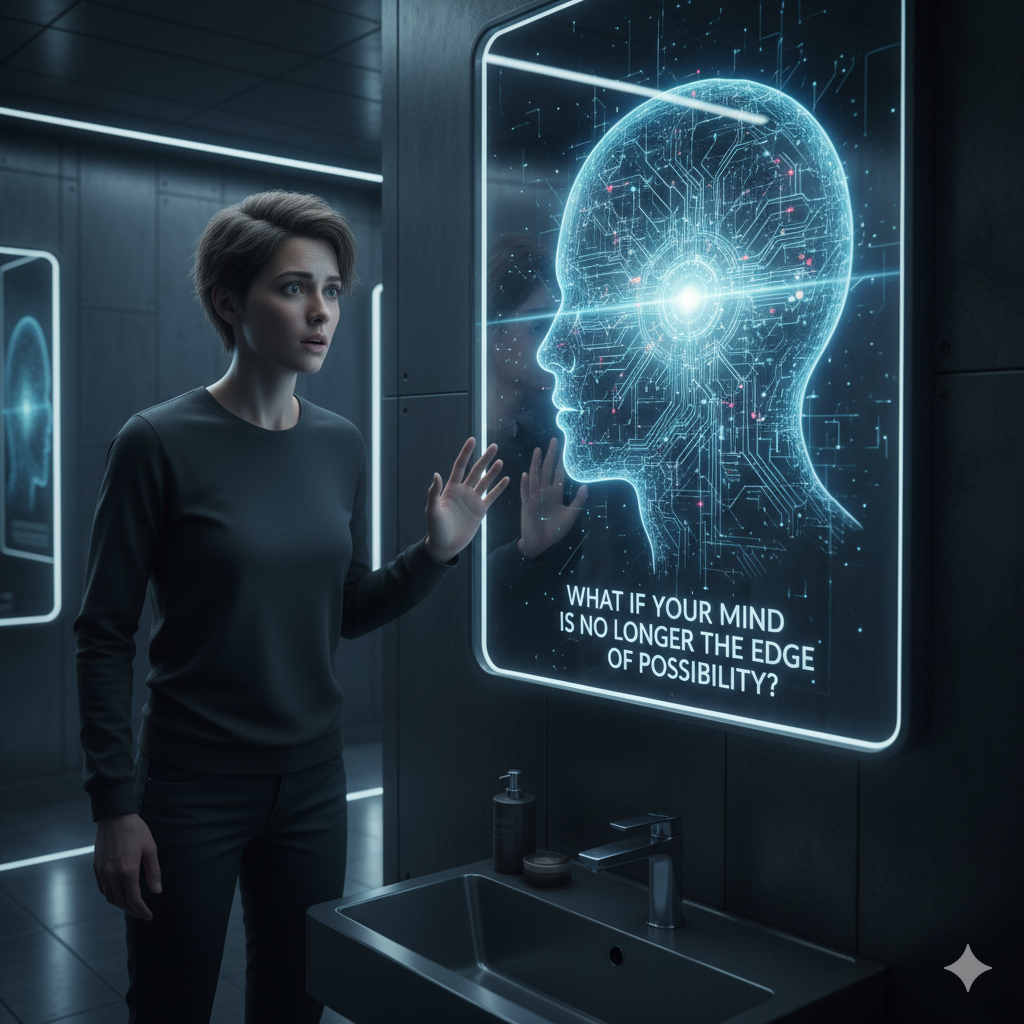
But one thing is clear: the edge of possibility is no longer defined by the human mind alone.
And that may be the most important intellectual shift of our time.
When you reach the top of the mountain, keep climbing.