Founder Health, Impact & Scale Framework
A lifecycle-aware, founder-centric system for managing startup health, financial discipline, verified impact, and personal capacity.
Core Principles
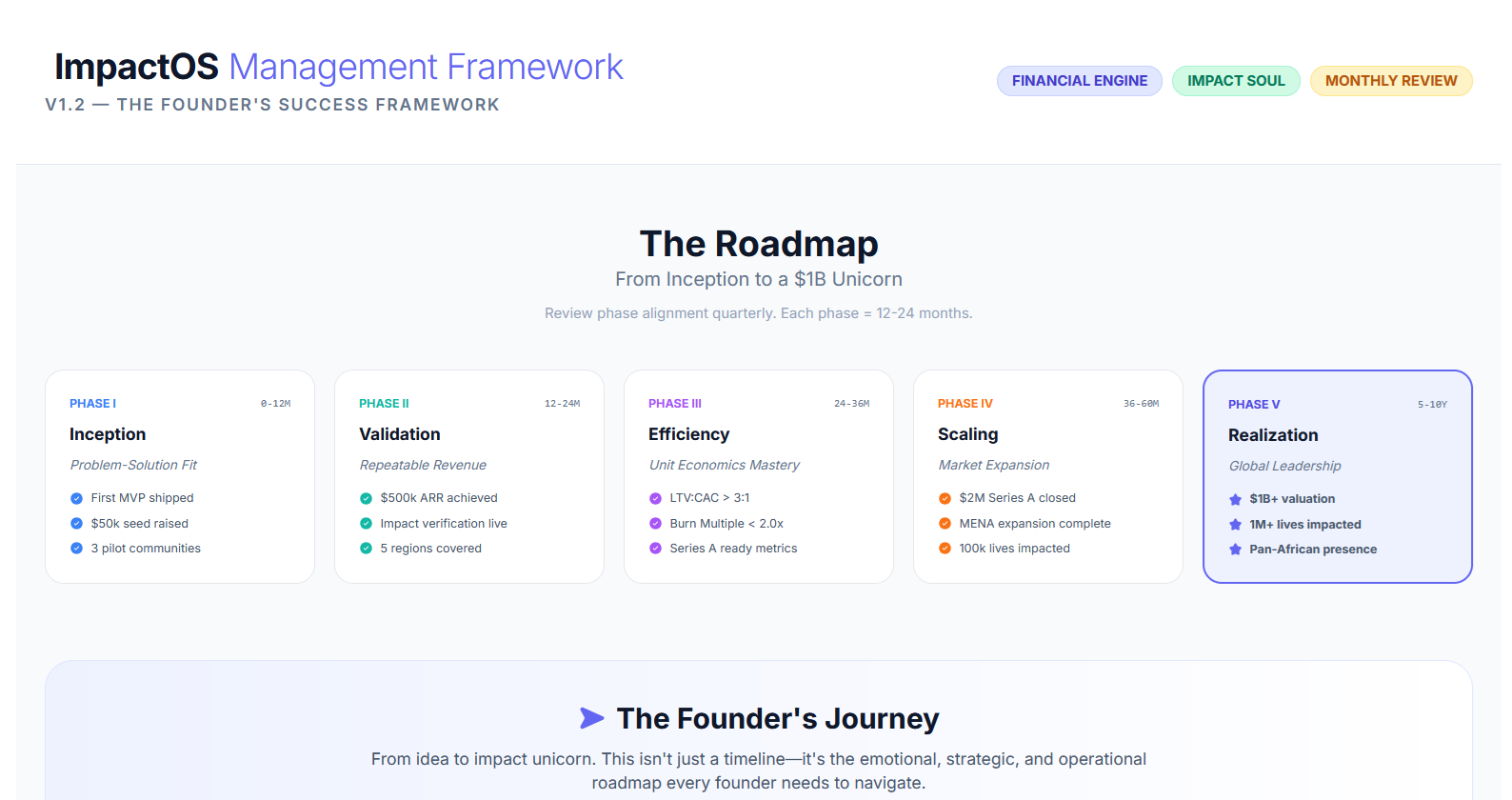
1. Phase States & The Journey
The “Phase Confidence Score” (PCS)
Think of this as your “Readiness Check.” Just because you can raise money doesn’t mean you are ready to scale.
0–12 Months
Phase I: Inception
The Problem-Solution Dance
Phase I: Inception
The Problem-Solution Dance
Focus Areas
- Customer Discovery: Find 50 people with the problem. Do they care?
- MVP: Build the ugliest, simplest version that solves the core issue.
- First Champions: Find 3–5 customers who love your vision.
- Impact Definition: Decide what you are measuring (e.g., “1 tree planted”).
⚠️ Top 5 Risks
- Building in Isolation (The “Lab Rat” trap).
- Cash Burn Misalignment (Spending on ads before product exists).
- Team Fragility (Co-founder disputes).
- Market Misreading (Solving a problem that doesn’t exist).
- Impact Washing (Claiming you save the world with zero proof).
You found 3 customers with a burning pain point, built a prototype in 90 days, and defined your impact unit.
12–24 Months
Phase II: Validation
From Love to Revenue
Phase II: Validation
From Love to Revenue
Focus Areas
- Pricing: Find the price point where customers buy without hesitation.
- Sales Playbook: Write down how you sell so you can hire someone else.
- Impact Proof (Internal): Use internal data as Proxy for impact.
- Core Team: Hire first non-founder managers.
⚠️ Top 5 Risks
- Premature Scaling (Hiring sales reps before you know how to sell).
- Feature Creep (Adding buttons instead of fixing the core).
- Burn Rate Acceleration.
- Founder-CEO Transition (Struggling to delegate).
- Impact-Revenue Gap (Making money but losing mission).
10–20 paying customers, steady revenue, and internal data confirms impact.
24–36 Months
Phase III: Efficiency
Mastering the Money Machine
Phase III: Efficiency
Mastering the Money Machine
Focus Areas
- Metric Mastery: LTV:CAC (SaaS) or Cash Cycles (Marketplace).
- SOPs: “Standard Operating Procedures.” Write manuals.
- Data Dashboard: Automate your reports.
⚠️ Top 5 Risks
- Growth Plateau.
- Culture Dilution.
- Burn Multiple Spiral.
- Impact Dilution.
- Competitor Response.
Margins healthy, cash flow positive (or trending), team works without you.
36–60 Months
Phase IV: Scaling
Market Domination
Phase IV: Scaling
Market Domination
Focus Areas
- Expansion: New countries or product lines.
- Executive Team: Hiring VP-level leaders.
- Verified Impact: Mandatory Third-Party Audit.
- Brand: Becoming the “Category King”.
⚠️ Top 5 Risks
- Cultural Missteps (Failing in new country).
- Cash Flow Mismatch.
- Execution Debt.
- Founder Burnout.
- Impact Verification Gap.
3+ regions, impact certified, 18+ months runway.
5–10 Years
Phase V: Realization
The Legacy
Phase V: Realization
The Legacy
Focus Areas
- Pan-Regional Power: Presence across the region.
- Policy Shaping: Working with governments.
- Ecosystem Building: Investing in next wave.
- Succession: Planning the exit.
⚠️ Top 5 Risks
- Innovator’s Dilemma.
- Bureaucracy Creep.
- Mission Drift.
- Founder Identity Crisis.
- Global Competition.
Verify >95% impact, company grows even if you take a 6-month vacation.
Golden Rules for Every Phase
Know your runway; never < 6 mo.
Great teams outperform mediocre ideas.
Must grow proportionally.
Focus obsessively on the phase key metric.
Fast decisions beat perfect decisions.
Most important asset. Protect it.
STOP: Calibrate Before You Measure
Do not use this framework without declaring your “Type” first.
Asset/Infra Heavy
Ops-Heavy / Marketplace
GovTech / Regulated
Deep Impact
Part 1: The Financial Engine
Infra: Calc Liquid Runway separately from CAPEX.
GovTech: Measure “Contract Value Added” quarterly.
Infra: Exclude CAPEX assets from Burn.
Commerce: Prioritize GMV Retention/Order Freq.
Ops/Agri: 15-20% acceptable if volume high.
Critical for EdTech/SaaS survival.
GovTech: Green zone extends to 12 months.
Super-App: Only count HQ staff (not drivers).
Part 2: The Impact Soul
If Revenue ↑ but Impact ↓ = Mission Drift.
Climate: Must be 100% Audited from Day 1.
Part 3: Meta-Layer & Zones
Founder Health & Risks
-
21. Decision Latency (Thndr Protocol)
Time from Signal → Decision. Founder stalling penalizes score. Regulatory stalling does not. -
22. Power & Dependency
Risk Check: Single client >40% revenue? Single Gov license? = “Red Zone”. -
23. Founder Health Index
Isolation >3 weeks since mentor talk = Danger.
Recovery <2 days off in 90 days = Danger.
🟢 Green Zone
Action: Continue & Optimize.
🟡 Yellow Zone
Action: Monitor closely.
🔴 Red Zone
Action: IMMEDIATE intervention.
🔵 Blue Zone
Action: Scale with caution.
Founder Rules (Unbreakable)
8. Practical Examples
Example 1: B2B SaaS (Inception)
-
Cash Runway
9 months (Yellow) -
MRR Trend
+10% MoM (Green) -
Burn Multiple
1.5x (Healthy) -
Phase Confidence
65% (Caution) -
Founder Energy
Moderate (Track)
Example 2: GovTech (Validation)
-
Rev Velocity
Slow but Signed (Green) -
Impact Verif.
Internal Only (Yellow) -
Geo Reach
2 Governorates (Yellow) -
PCS Score
70% (Fragility Detected) -
Founder Health
Stressed (Support Needed)
9. How to Use ImpactOS
Track all KPIs and update dashboards.
Recalculate PCS, identify risks, decide interventions.
Use simple traffic-light indicators.
Adjust strategy before problems become critical.
Founder’s Dictionary
Financial Metrics
-
MRR / ARR
Monthly / Annual Recurring Revenue. The predictable
“heartbeat” of subscription income. -
LTV : CAC
Life Time Value vs Customer Acquisition Cost. Profit
per customer vs cost to acquire them. -
Burn Multiple
Net burn divided by net new ARR. Measures capital
efficiency in growth. -
NRR (Net Revenue Retention)
Starting MRR + Expansion – Churn, divided by Starting
MRR. Measures existing customer health.
Impact Metrics
-
Impact Unit
Standardized measure of impact (tons CO₂ reduced,
liters saved, lives improved). -
SDG Coverage
The UN’s 17 Sustainable Development Goals—the global
language for measuring impact. -
Verification Rate
Percentage of impact claims verified by third-party
audit. No proof = No impact. -
ESG Premium
Additional valuation multiple or price premium
attributable to strong ESG performance.
Tools & Measurement
Leading: Predict future performance (sales pipeline).
Lagging: Historical results (revenue).
ERP (financials), CRM (customers), Impact Dashboard
(impact metrics), HRIS (employee data).
ERP: Accounting
CRM: Customers
SHOP: Sales
Metric Classification
Leading Indicators (Predict Future)
-
Sales Pipeline Value: Predicts future revenue -
Customer Satisfaction (CSAT/NPS): Predicts retention -
Product Engagement: Predicts expansion & churn -
Team Happiness Score: Predicts productivity
Lagging Indicators (Measure Past)
-
Revenue/ARR/MRR: Historical performance -
Profit Margins: Past efficiency -
Churn Rate: Historical customer loss -
Impact Units Delivered: Past impact achieved
Balance leading and lagging indicators for complete
picture. Review leading indicators weekly, lagging monthly.